
You’re sitting in a café in Portland, laptop open, scrolling through yet another DTC brand that just launched a backpack and sold out in two weeks. And you think, “I could do that. I’ve got the taste. I know exactly what’s missing.”
Then reality hits: you have zero experience in production. No factory contacts. No tech pack. No clue what MOQ stands for.
Here’s the good news: almost every small bag brand you admire started exactly there. And a surprising number of them found their way to one specific dot on the map — Shiling, Guangzhou. It’s where our factory is, and we’ve seen this movie play out hundreds of times.
If you’re a solo founder or tiny startup, this is the roadmap we’ve seen actually work.
1. Don’t try to build a “bag brand.” Build a bag for your people.
The quickest way to burn your savings is to launch a generic tote, a generic backpack, and hope everyone buys it. Big brands already own that space.
Instead, pick a tribe. Are you making the ultimate anti-theft crossbody for female cyclists? A gym bag for aerial yoga people who need somewhere to hang their silk ropes? A weekender that actually fits a pair of dress shoes without crushing them?
Go niche, almost embarrassingly so. Find three subreddits, Facebook groups, or Instagram hashtags where people complain about what’s missing from current bags. That’s your brief.
What we’ve learned from our clients: the brands that win are not the ones with the best leather. They’re the ones where a customer looks at the bag and says, “Oh, they get me.”
2. You don’t need to be a designer. You need to be a clear thinker.
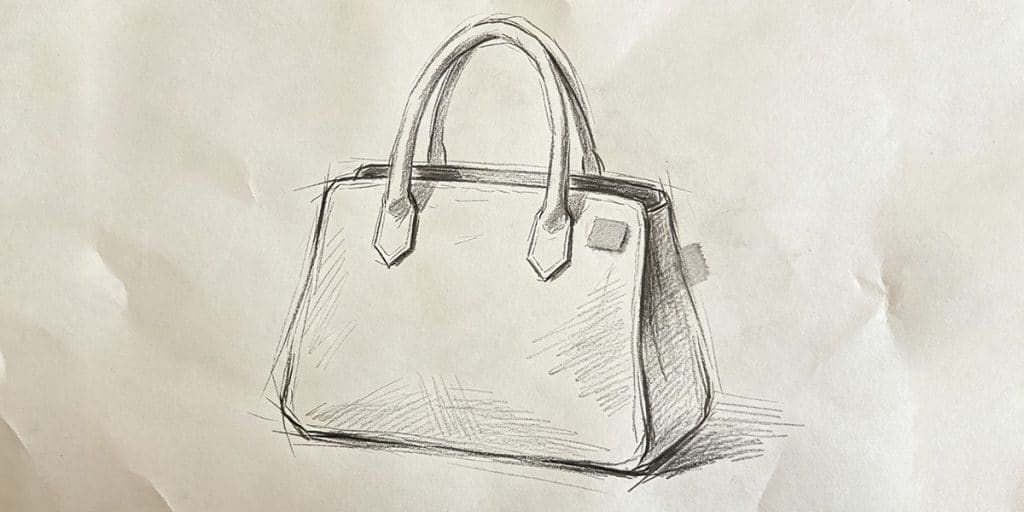
We talk to founders almost daily who apologise for their sketches. It’s fine. Some of our best-selling designs started as a photo of a napkin doodle, or a mood board with arrows and notes saying “like this, but wider” and “zipper here instead.”
What matters is that you can communicate three things:
- The general shape and size (even a rough sketch with dimensions scribbled on works)
- The key functional details (pockets, closures, strap drop)
- The vibe: materials you love, bags that feel close to your idea
If you can send us a couple of reference images and a messy list of changes, our in-house pattern maker can translate that into a proper tech pack. You don’t have to do that part alone.
3. Find a manufacturing partner that doesn’t treat you like a rounding error.
This is where most solo founders run into a wall. They email five factories, and four reply with “MOQ 1000” and ghost after that. It feels personal. It’s not — they’re just set up for big runs.
Shiling is different. It’s less like a single giant factory, and more like an entire ecosystem that grew up around soft goods. Need a custom matte-black buckle? Our hardware guy is a ten-minute scooter ride away, not a three-week email chain across borders. Want to switch the lining to recycled polyester last minute? Doable, because the lining supplier is two blocks over.
What to look for in a partner:
- They’re comfortable with small runs — even 100 pieces to test the market.
- They understand EU/US standards without you having to teach them (REACH, California Prop 65, lead-free zippers, all of that).
- They reply like an actual human, not a quoting robot.
When you reach out, just be upfront: “Here’s my reference, my budget roughly here, and I’d like to start with 100 pieces if possible.” A good partner will help you adjust materials or construction to hit your target, rather than just saying no.
4. Sample like your brand depends on it. Because it does.
It’s tempting to see the prototype photo and say “ship it.” Don’t.
Get the physical sample in your hands. Use it for a week. Stuff it with your actual daily junk. Open and close that zipper a hundred times. Let the strap dig in. See if the magnet closure actually holds when you toss it onto the passenger seat.
Then find five people who match your target customer and watch them interact with the bag. Pay attention to what they don’t say — the hesitation, the “it’s nice, but…” That feedback is gold.
When you send revision notes back to the factory, be specific: “The inside pocket opening needs to be 2cm lower,” or “can we change the hardware to something closer to a brushed gold, similar to this photo?” We’d much rather get that level of detail than “make it better.” It saves everyone time.
5. Set up your shop before you have inventory.
A solo founder’s best friend is a simple Shopify store, a decent batch of lifestyle photos (you and a couple of friends, natural light, honest moments), and one social channel where you actually show up.
You don’t need a full brand film. You don’t need fifty SKUs. One well-photographed bag, a straight-talking product description, and a “why I made this” origin story page will do more for your launch than a whole lookbook.
Also, don’t hide your supply chain. More and more EU/US customers actually want to know where and how the bag is made. A simple note like “designed in Berlin, responsibly produced in a small family-run workshop in Guangzhou’s leather district” is a trust signal, not a liability.
6. Get it to your customer
Small first batch? Ship it by air. It’ll land in 5-7 days to most EU and US addresses. You’ll get cash flow moving and real market feedback faster than optimizing for ocean freight on 80 units.
A competent manufacturer handles export docs, fumigation certificates if needed, and customs clearance coordination. You just need to have your own freight forwarder or a postal solution on your side, and they’ll walk you through the rest.
The part most brands don’t talk about
We’ve been on the factory side of a lot of “bedroom brand” origin stories. One founder started with 60 canvas totes and a strong opinion about interior pockets; two years later she was in 40 brick-and-mortar boutiques across the Netherlands. Another made a diaper bag that solved her own back-pain problem, and now it’s her full-time income.
None of them had it all figured out at the start. They just had a sharp idea, a little humility, and a manufacturing partner who didn’t mind small beginnings.
If you’re sitting on a bag idea right now — even if it’s still mostly in your head — feel free to reach out. We’re in Shiling, Guangzhou, and we specialise in helping tiny brands do their first small production run, handle sampling, and navigate all the details that sound intimidating until someone translates them into plain English.
We’d be happy to hear what you’re building.