

AI tools like Midjourney have turned everyone into a designer. In minutes, you can generate a dozen luxury handbag concepts—wild shapes, intricate hardware, editorial-level visuals. It’s fast, it’s inspiring, and it’s dangerously misleading.
Because a bag that looks incredible on screen can become a complete nightmare in sampling.
We’re a handbag manufacturer. Every week, we get AI-generated designs from clients who are convinced they’ve cracked the code. Then we start quoting. And almost without fail, the same three problems appear: surface decoration costs, custom hardware traps, and structural logic that doesn’t hold up in real life.
If you’re using AI to develop a bag, here’s what you need to know before you hit send.
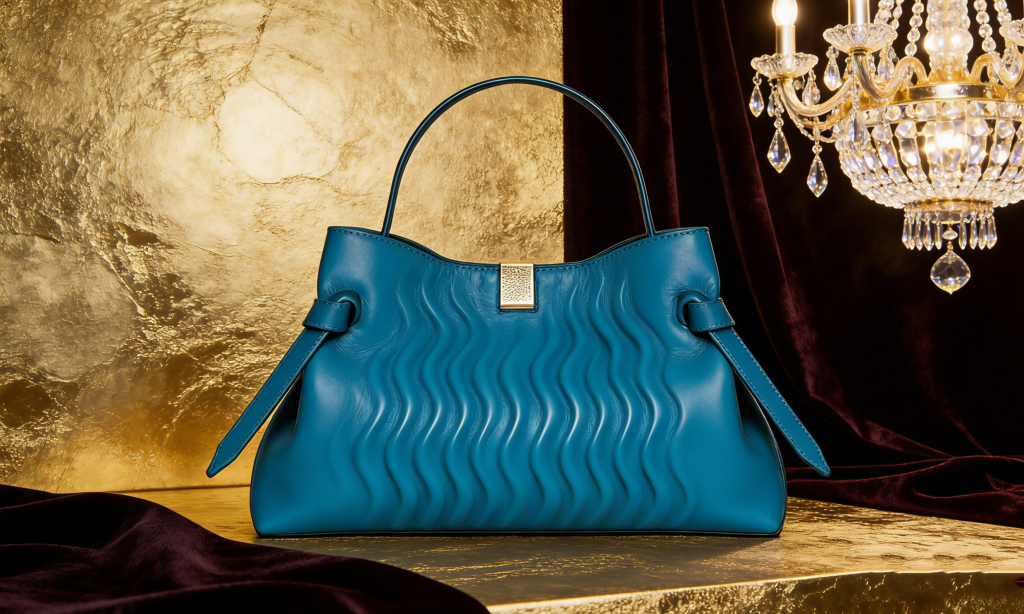
1. That Stunning Surface Detail? It Comes With a Tooling Bill
A client recently sent us an AI concept: a structured tote covered in an irregular 3D logo pattern, layered with multi-color digital printing. On screen, it looked like a high-fashion statement piece.
The actual cost came in at nearly four times their target retail margin.
Why it happens:
AI treats texture like a visual effect. Factories treat it like a manufacturing process.
- Raised surfaces require molds. If your design has embossed logos or sculptural patterns, each unique element may need its own steel tool. For small runs, tooling alone can blow the budget.
- Complex printing adds risk. Multi-color gradients and photorealistic details look great on a render. In production, they mean higher setup costs, tighter registration tolerances, and more scrap.
What we recommend:
Separate “must-have” details from “nice-to-have” ones.
If your run is small, swap custom embossing for laser engraving—lower upfront cost, still high visual impact. For prints, limit the color palette. In many cases, a well-chosen leather with natural grain will feel more premium than a complicated surface treatment that gets lost in translation.
Ask yourself before sampling:
- Are these surface details flat (engraved/printed) or raised (embossed/molded)?
- If raised, does each element require its own mold?
- Could a better base material deliver the same look without custom tooling?
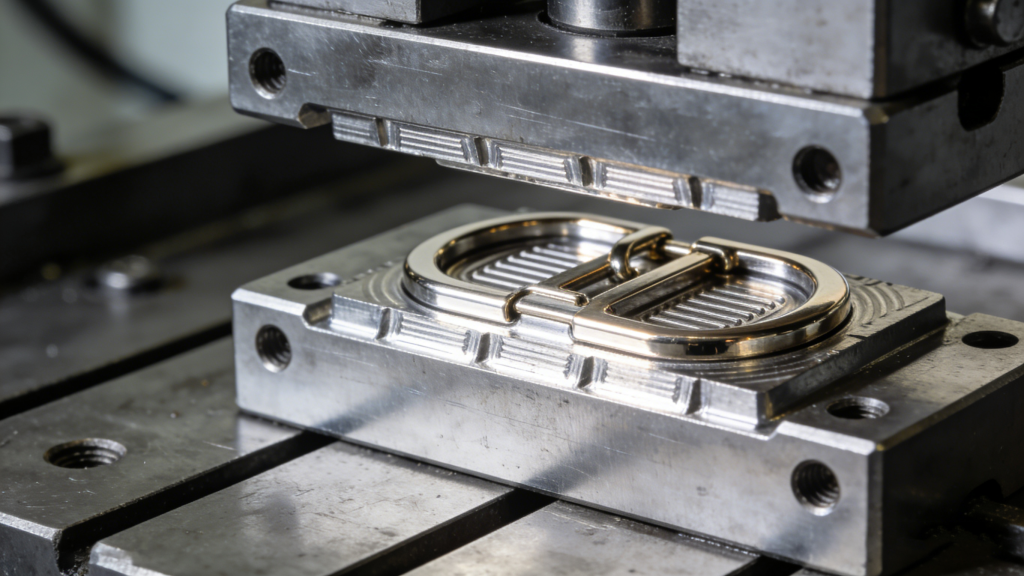
2. Custom Hardware Looks Great—Until You See the MOQ
Hardware is where AI concepts go to die financially.
AI doesn’t know what a standard mold looks like. So it generates sculptural locks, asymmetrical buckles, custom zipper pulls—all visually exciting, all requiring brand-new tooling.
The problem:
In the real world, standard hardware (D-rings, feet, strap sliders) runs on existing molds. It’s cheap and scalable. Custom hardware means paying for new molds, and those molds come with minimum order quantities that often dwarf what a new brand actually needs.
If your design calls for a custom lock, custom zipper, custom feet, and a custom buckle, you’re looking at four separate mold charges—and a supplier who may not even talk to you for fewer than 1,000 units.
What we recommend:
Choose one piece of hardware to go custom. Usually, that’s the front closure or the logo plate—the thing people actually notice. Everything else should come from the factory’s catalog.
We call this the “hero hardware” approach. You get the signature detail you want, without committing to high MOQs on functional parts that nobody pays attention to.
Ask yourself before sampling:
- Which hardware piece is essential to the brand identity?
- Which parts are purely functional and can be standard?
- Does your projected quantity justify the mold costs?
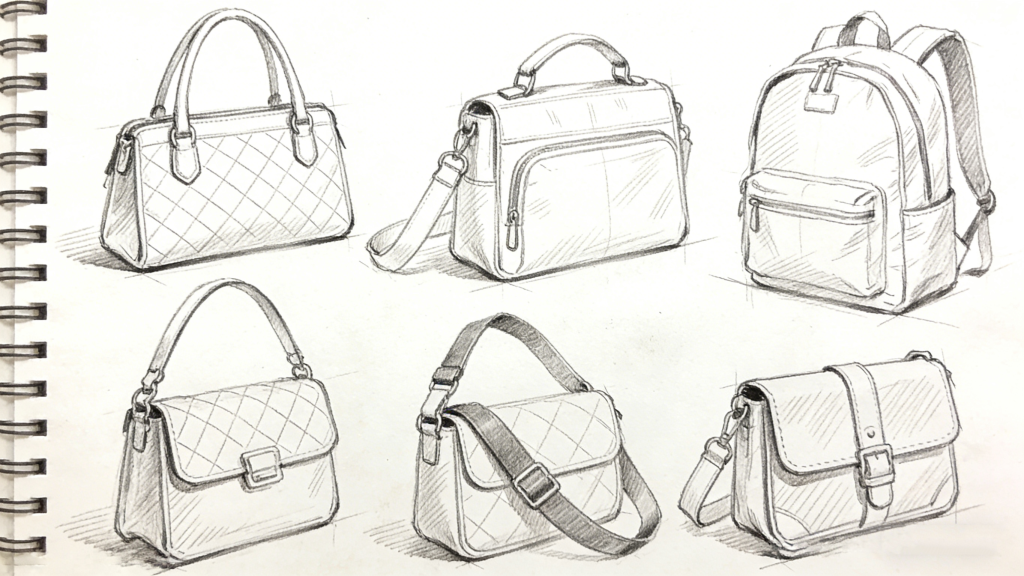
3. AI Doesn’t Understand Gravity, Weight, or Stress Points(AI Ignore Physical Reality)
This is the most common failure we see: a bag that looks perfect in a render but collapses under its own weight.
Example: a slouchy, soft leather body paired with oversized metal hardware, attached to thin handles. Visually, it works. In real life, the first time someone puts a laptop inside, the handles tear, the hardware pulls through the leather, and the bag loses its shape permanently.
Why it happens:
AI generates a “skin.” Factories have to build a skeleton.
- Weight needs reinforcement. Heavy hardware can’t just hang off soft leather without internal support (webbing, Salpa, fiberboard).
- Shape requires structure. A sharply architectural bag can’t be made from unstructured leather. You need heat-molded EVA, structured leather types, or internal reinforcement.
- Handles aren’t just decorative. They need internal cores (rope, steel wire, tubing) to bear load.
What we recommend:
Use AI for silhouette inspiration, not construction instructions.
Before sampling, a skilled pattern maker needs to translate that image into a tech pack that specifies materials, thickness, reinforcement points, and seam allowances. If your render shows heavy hardware, the tech pack must show how it’s anchored. If it shows a sharp shape, the tech pack must define the structural layers that make it possible.
Ask yourself before sampling:
- Does the handle design match the expected weight of the finished bag?
- Are there internal reinforcements specified to maintain the shape?
- Have stress points (strap attachments, lock mounts) been engineered for durability?
What Factories Actually Need From an AI Design
If you’re serious about developing a bag, don’t just send an image and hope for the best. Factories need context to give you an accurate quote and a sample that actually matches your vision.
Provide this upfront and you’ll save weeks of back-and-forth:
- Target price and quantity — Be honest about whether this is a $100 retail bag or a $1,500 retail bag, and whether you’re making 50 units or 5,000.
- Material type — “Red” isn’t enough. Is it patent leather, nubuck, canvas, or vegan leather? Each behaves differently.
- Hardware intent — Mark which metal parts must be custom and which can be standard.
- Structural reference — If you have a physical bag with the right “hand feel” or structure, share it. It’s worth more than a dozen renders.
Final Thought: AI Is a Great Design Partner, but a Terrible Engineer
AI tools have made the front end of fashion development faster and more creative than ever. That’s a good thing. But the gap between a concept image and a production-ready bag is still huge, and it’s filled with things AI can’t see: tooling costs, material limits, structural engineering, and supply chain reality.
The brands that succeed are the ones that use AI for inspiration, then work with manufacturers to translate that vision into something that can actually be sewn, assembled, and shipped—without breaking the budget or the product.
If you’re developing from an AI concept, bring your manufacturing partner in early. The sooner you align on structure, materials, and hardware strategy, the fewer surprises you’ll have when the first sample arrives.
FAQ
Can I just send an AI image to a factory and ask for a sample?
You can, but expect a rough process. Factories need technical specifications—materials, dimensions, construction details—to quote accurately. An image alone usually leads to guesswork and cost overruns.
Why do AI designs tend to cost more than expected?
Because AI generates custom everything: unique hardware, complex embossing, multi-step prints. Each of those requires upfront tooling, which adds cost that’s often overlooked in the creative phase.
How do I keep hardware costs under control?
Customize only the most visible piece (usually the front lock or logo). Use high-quality standard hardware for everything else. This preserves the design intent without multiplying tooling costs and MOQ requirements.
What’s the most common structural mistake in AI-generated bags?
Putting heavy hardware on soft, unreinforced leather. Also: designing sharp, structured shapes without specifying internal reinforcement. AI treats leather as infinitely strong and shape-retaining; real leather isn’t.
What should I prepare before contacting a manufacturer about an AI design?
Target retail price, estimated order quantity, material preferences, and any physical reference bags that match the structure or feel you’re after. The more detail you provide upfront, the faster and more accurate the development process will be.