
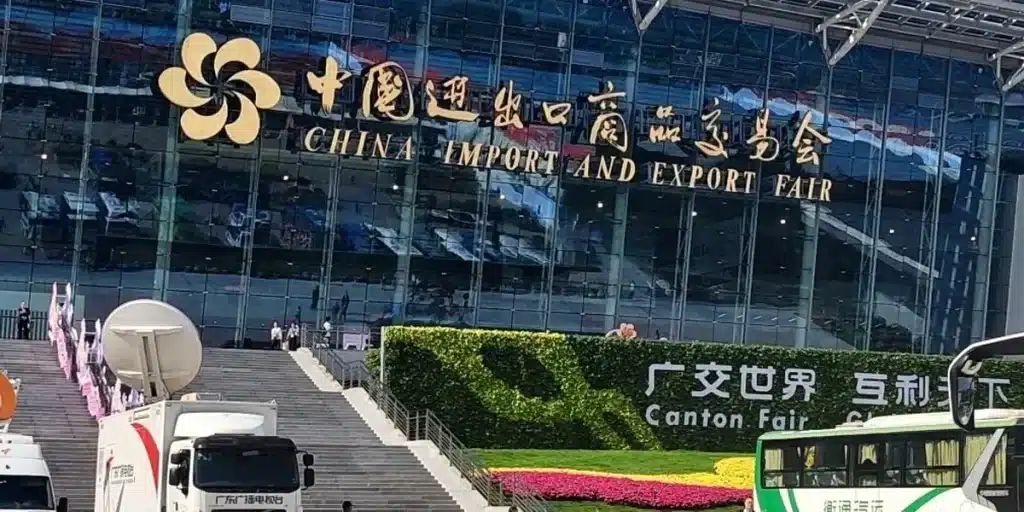
If you’re in the B2B bag and luggage industry, you’ve probably asked yourself at some point: should we do the Canton Fair?
It’s the biggest trade show in China, maybe the world. Every April and October, thousands of suppliers pack into Pazhou, hauling sample bags and business cards, hoping to land that one big buyer who’ll keep their factory busy for the next six months.
At Momocolor, we get asked this question a lot. And our answer is simple: we don’t go.
Not because we don’t respect the fair — it’s been the backbone of Chinese export trade for decades. But after running the numbers and watching how the industry has shifted, we decided a long time ago that it’s not the right fit for us.
Here’s why.
Reason 1: We’re a small, focused operation — and that’s by choice
Let’s start with the most honest one: we’re not a huge factory.
We’re a mid-sized bag manufacturer specializing in custom OEM/ODM projects. We work with a curated list of clients, mostly small-to-medium brands and startups that need flexibility, fast sampling, and lower minimum order quantities. We’d rather do great work for 20 solid clients than chase 200 leads and spread ourselves thin.
The Canton Fair favors scale. The best booths go to companies with proven export volumes (the official threshold for coastal manufacturing enterprises is USD 750,000 in annual exports)China Impo…. If you’re below that line, you either don’t qualify for a booth at all, or you end up in a back corner where foot traffic is thin.
And here’s the irony: the companies that can easily get prime booths often don’t need the fair as much. They already have established client bases and sales channels. The smaller companies that could really use the exposure are the ones who can barely get in the door.
We’d rather invest in being really good at what we do than stretch to hit arbitrary export thresholds just to qualify for a booth.
Reason 2: The ROI is unpredictable — and often disappointing
Everyone quotes the official booth price — around RMB 21,500 for a standard 9m² booth in the bags section — and thinks, “that’s manageable.”广州市商务…
But that’s just the entry ticket. The real costs pile up fast:
- Booth construction and design: Even a basic custom build adds another RMB 10,000–30,000. If you want something that actually stands out? More.
- Samples and logistics: Shipping dozens of sample bags, display fixtures, and marketing materials.
- Staff and travel: Flights, hotels, meals, and 5+ days of your best salespeople’s time.
- Client entertainment: Dinners, meetings, airport pickups — it all adds up.
All in, a single standard booth can easily cost RMB 50,000–100,000 by the time you’re done. A larger custom booth? RMB 100,000–200,000 is normal.
And what do you get for it?
A lot of business cards, for sure. But in recent years, conversion rates have dropped sharply. Most buyers walking the floor already have stable suppliers in China. They’re not there to find a new main vendor — they’re checking prices, hunting for new product ideas, or collecting quotes to negotiate down their current supplier.
We’ve spoken to plenty of peers who come back with 200+ contacts, follow up diligently for months, and land one or two sample orders — not enough to cover the cost, let alone turn a profit.
When we can run targeted Google Ads, SEO, and direct outreach campaigns for the same budget and track every dollar with precision, dumping a lump sum into a trade show where results are a coin flip just doesn’t make sense.
Reason 3: It’s a price war, not a partnership conversation
Walk the bags section at Canton Fair and you’ll see the same thing everywhere: rows and rows of nearly identical products.
When every booth is selling similar polyester backpacks, nylon duffels, and PU handbags, the only differentiator becomes price. Buyers go from booth to booth, asking for your best FOB price, then walking next door to see if the next factory will beat it by 5 cents.
That’s not the game we want to play.
We build custom bags for brands that care about design details, material quality, ethical production, and reliable lead times. Those conversations take time. They happen over video calls, sample iterations, and factory visits. They don’t happen in a 3-minute walk-by at a crowded trade show.
If your competitive advantage is “cheapest per unit,” the fair is a great place to prove it. If your value is anything else, it’s an uphill battle.
Reason 4: The way buyers source has changed
Ten or fifteen years ago, the Canton Fair was the main way international buyers found Chinese suppliers. If you wanted to source bags from China, you hopped on a plane and went to Guangzhou.
That’s no longer true.
Today’s buyers research suppliers online first. They search Google, browse Alibaba, read industry blogs, and check LinkedIn. They narrow down their shortlist digitally, and only reach out when they’re already interested. When they do fly to China, it’s usually to visit specific factories they’ve already vetted — not to wander a show floor blind.
We’ve built our entire business around this reality. Our website, our sample program, our digital communication workflows — everything is designed for buyers who research online first. And it works. Most of our new clients find us through search or referrals, not trade shows.
So who should attend the Canton Fair?
Let’s be fair — the Canton Fair isn’t bad. It’s just not for everyone. It works extremely well for certain types of bag companies.
It’s a good fit if you’re:
1. A large factory with standard, high-volume products
If you produce mass-market backpacks, travel luggage, or promotional bags in huge quantities, and your main selling point is competitive pricing and large capacity, the fair puts you in front of exactly the buyers you want: big importers, chain retailers, and wholesalers looking for volume.
2. A newer company with no existing client base
If you’re just starting out and have almost no international customers, the fair is one of the fastest ways to collect a large number of leads in a short time. The quality might be mixed, but quantity-wise, nothing beats it.
3. You sell products that really need to be touched and seen
Bags are tactile products. Leather quality, hardware feel, stitching details — some buyers genuinely need to see and feel them in person. If your product line relies heavily on in-person evaluation, the fair has real value.
4. You’ve got a brand booth in a good location
Not all booths are equal. The prime A-area brand booths get dramatically more traffic and higher-quality buyers. If you’ve qualified for one of those and you know how to work the show, the ROI can be excellent. The problem is, most companies never get there.
And what kind of buyers go there?
- Large importers and distributors looking for high-volume, low-cost supply
- Old-school buyers who prefer face-to-face meetings and have been attending for decades
- Buyers who want to compare 10+ suppliers in one trip efficiently
- Southeast Asian, Middle Eastern, and African buyers who prioritize lowest price above all
- Retail chains doing seasonal product scouting
What we do instead
We don’t do trade shows, but we don’t hide either.
We invest in our website, so buyers can find us when they’re searching for exactly what we make. We publish detailed product information, case studies, and factory photos so prospects can vet us before they ever reach out. We run a fast, transparent sampling program. We do video calls and virtual factory tours. And when clients are ready to visit in person, we host them at our factory — where they see our actual production lines, not just a polished booth.
It’s slower than a trade show. It’s more work in some ways. But it attracts the right kind of clients — people who value quality, communication, and long-term partnership over the absolute rock-bottom price.
And for a company our size, that’s a much better investment.
If you’re a bag brand looking for a manufacturing partner that doesn’t play the trade show price-war game, we’d love to hear from you. Drop us a line and tell us what you’re working on.